As manufacturing moves towards large-scale and lean production, small-batch, multi-order orders are becoming increasingly common, making order management more complex. Order allocation is the first hurdle before production begins, especially for companies with multi-factory production models. Order allocation has a significant impact on production and delivery efficiency, and different allocation methods can lead to significant cost differences.
Traditional order allocation models typically rely on manual decision-making or follow fixed, standardized patterns. This results in low efficiency, difficulty in comprehensively considering all factors, and significant waste of production resources and costs. So how can companies optimize order allocation?
Multi-factory order splitting: a game of decision-making regarding delivery time, capacity, and revenue.
Before analyzing the solution, let's look at the challenges of order splitting across multiple factories. Every company considers three issues when splitting orders: delivery time, capacity, and revenue. Strictly speaking, all three are important, but each company's situation is different, and the priorities vary, often leading to situations where one aspect is neglected. Cordless Vacuum Cleaner China
At the same time, due to technological limitations, accurately calculating all factors for each issue is a significant challenge for enterprises. Delivery time, production capacity, and revenue are not single-dimensional issues; they are interconnected and influence each other. Systematically identifying and quantifying these influencing factors is also a huge challenge. This is especially true for large enterprises whose production may involve hundreds of factories, thousands of workshops, and production lines across different regions, where the difficulty of order allocation is self-evident.
In summary, companies often face the following problems when allocating orders:
First, blindly pursuing delivery dates while neglecting production capacity and costs can lead to an increase in orders but not necessarily in revenue. While delivery dates are crucial , production should not be undertaken without regard to cost. If an order is due at the end of May, but a shortage of a certain raw material necessitates additional procurement costs, causing the total cost to exceed the order's revenue, the company should consider communicating with the customer to postpone delivery.
Secondly, unreasonable factory capacity matching leads to waste of resources and costs. Orders vary in quantity, and factory capacity varies; they are not necessarily in a one-to-one correspondence. Some orders require specific factories, while some factories can handle the production of several orders simultaneously. For example, assuming 10 factories can produce a certain batch of orders, it's unlikely that all 10 factories will be involved. Some factories with larger capacities can handle the production of 5 orders, giving the company more options when allocating orders. In standardized batch production, the higher the production quantity, the lower the cost. If a factory can produce as much as possible per machine operation, it can reduce machine wear and tear.
Third, calculating costs and benefits is complex. When calculating benefits, one cannot only look at the order amount; the underlying costs must also be considered. Many companies, when calculating costs, typically focus on obvious costs such as materials and labor, easily overlooking potential costs such as transportation and logistics. For example, factories in remote areas may have lower labor costs, but higher raw material transportation and shipping costs. Conversely, factories in nearby areas may have higher labor costs, but faster and lower transportation costs. Therefore, to comprehensively and scientifically compare costs, one cannot consider raw material and labor costs in isolation.
Is there a way to comprehensively consider all these factors and allocate orders? Intelligent decision-making technology based on operations research and machine learning can transform the order allocation problem into a mathematical problem for optimization, bringing new solutions to the order allocation problem.
Intelligent decision-making unlocks the optimization secrets of multi-factory order splitting.
Intelligent decision-making is a process in which organizations or individuals comprehensively utilize various intelligent technologies and tools to model and analyze relevant data based on predetermined goals, and arrive at decisions. This process integrates factors such as constraints, strategies, preferences, and uncertainties , and can automatically achieve optimal decisions to solve increasingly complex production and life problems in the new era of growth.
In the intelligent manufacturing decision optimization platform —Shanshu Data Game — developed by Shanshu Technology , the demand allocation workbench enables intelligent upgrades for multi-factory order allocation. The system performs algorithmic modeling of factory data, allocation rules, and business requirements based on the enterprise's business characteristics. After order data is input, the system automatically considers factors such as order delivery time, cost, and revenue, aiming to maximize revenue. It efficiently solves the problem using the COPT solver, matching orders with the production capacity of different factories and outputting the optimal allocation result.
In the specific order allocation process, companies may have multiple requirements, such as lowest cost, shortest , and fewest number of factories. In the Shanshu Data Game system, companies can flexibly adjust models and parameters according to different needs, outputting different versions of order allocation results, and better optimize order allocation through comparison. For example, if the delivery time for a batch of orders is two months, the company can set constraints of a two-month delivery time and fewer than five factories to obtain the lowest-cost order allocation plan; alternatively, it can set constraints of a one-and-a-half-month delivery time and fewer than ten factories to obtain the lowest-cost order allocation plan. By comparing different allocation plans, companies can make more informed decisions based on specific circumstances.
Compared to traditional methods, the order allocation model based on intelligent decision-making overcomes the limitations . It can quickly respond to order changes and meet the order allocation needs under different business objectives. In terms of order allocation effectiveness, the overall decision-making is more scientific and economical, laying a solid foundation for subsequent production execution.
Unleash the value of long-chain operations and boost business growth
As a crucial link in manufacturing supply chain management , order allocation essentially fulfills demand plans and has a significant impact on subsequent production and shipping. Changes in order allocation models are not only reflected in order distribution but also radiate their value to the back end of the production chain, achieving ripple effects. The practices of leading companies also demonstrate that intelligent decision-making is helping enterprises achieve business transformation and profit growth.
For example, a large manufacturing company with multiple factories across the country used to manually allocate orders to different factories for production and delivery, incurring high logistics costs. As business grew and order volume exploded, manual order allocation became increasingly inadequate. To reduce costs and improve efficiency, the company developed an intelligent order allocation system based on Sugon Data. Through supply chain collaboration, it integrated pricing information from upstream logistics suppliers, downstream customer demand information, and factory capacity information to guide order allocation decisions for thousands of orders daily. By accurately depicting segmented logistics pricing costs, the system saved the company an average of over 10% in logistics costs annually, amounting to tens of millions of yuan in annual savings.
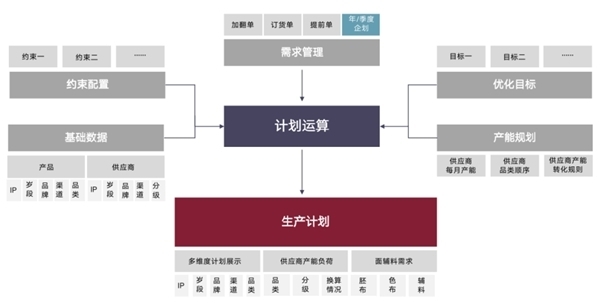
Semir Intelligent Order Scheduling Plan Overview
Take Semir, for example. As a domestic apparel giant, it owns more than a dozen apparel brands and mainly relies on hundreds of supplier factories across the country for production. Previously, when allocating production capacity and scheduling orders, it relied mainly on manual experience, which was highly subjective , inefficient, and difficult to optimize comprehensively. After introducing intelligent decision-making technology, Sugon assisted Semir in reorganizing the data and allocation rules of each factory and built an intelligent order scheduling system based on Sugon's algorithm. The system can automatically consider various factors affecting allocation and production, and optimize order allocation through intelligent algorithms and solvers. Order response speed has increased exponentially, order production cycle has been reduced, and customer satisfaction has been greatly improved through faster delivery time and more accurate order execution. At the same time, the company's management of hundreds of factories has become more efficient, supplier stickiness has been comprehensively enhanced, and production costs have been significantly reduced.
In conclusion, the order allocation model based on intelligent decision-making can not only connect orders and production resources and improve the flexibility , but also further optimize the supply chain structure, making sales, production, and supply more coordinated, effectively shortening the order delivery cycle, and making it more suitable for the production needs of small-batch, multi-order orders. In the future, with the advancement of intelligent manufacturing, flexible, efficient, and high-quality order allocation will become an essential capability for manufacturing enterprises, and intelligent decision-making will play an even greater role in the intelligent transformation of the manufacturing industry.